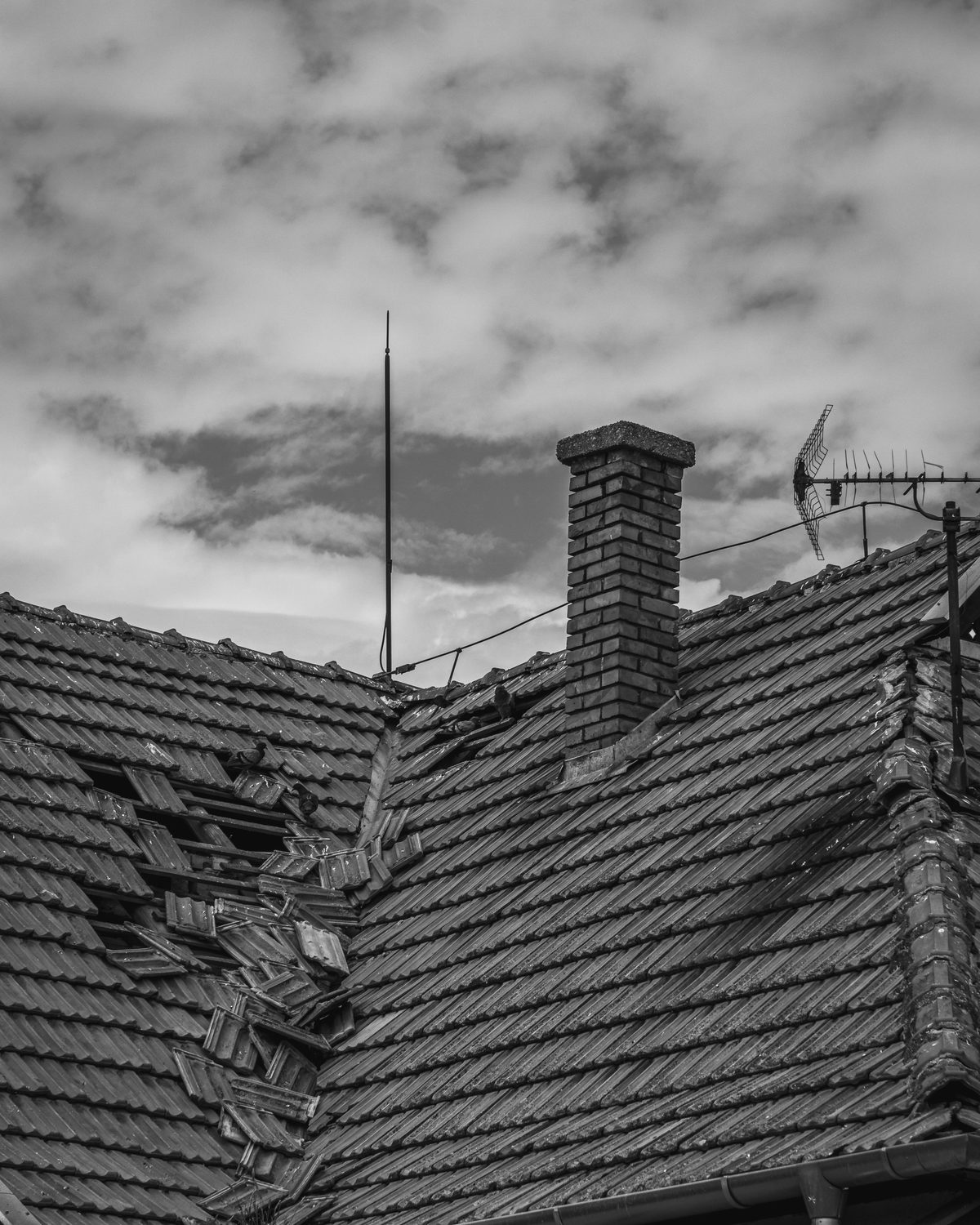
Wind and storm claims usually start with something visible: missing shingles or tiles, lifted edges, or debris across the roof. What decides the claim is less visible, and the first hours after the storm are when you can still capture it.
Wind damage is directional and progressive. It concentrates on the edges, the ridge and the slopes that faced the storm, it breaks the seals between shingles before it removes them, and it keeps working on every following windy day. Documenting it early is what separates a storm claim from an argument about an old roof.
Signs of wind damage
- Missing, lifted or creased shingles
- Slipped or broken tiles
- Loose or missing edge metal and flashing
- Membrane peeled back at the edges of a flat roof
- Debris impact, such as fallen limbs
- Granules washed into gutters and at the base of downspouts
- Ceiling stains, damp insulation or daylight visible in the attic
Check the yard and the fence line too. A downed limb, a shifted fence panel or a displaced gutter dates the event and shows the direction the wind came from.
Where wind damage hides
| Area | What the wind does | Why it matters to the claim |
|---|---|---|
| Rake and eave edges | Lifts the first courses and bends the drip edge | The usual starting point for progressive failure |
| Ridge and hips | Displaces caps and breaks their seal | Often visible only from the roof surface |
| Field shingles | Breaks the seal strip without removing the shingle | Unsealed shingles are damage even when nothing is missing |
| Flashing and vents | Loosens fasteners and lifts counterflashing | A common source of leaks weeks later |
| Flat roof perimeter | Peels the membrane back from the edge detail | Water enters the system under the surface |
Ask your inspector to report on each of these areas by name. A report that says the roof has wind damage is weaker than one that says which edge lifted, on which slope, facing which direction.
Protect the home first
Most policies expect you to prevent further damage. Tarp openings if it is safe, or have a roofer do it, and keep every receipt. Do not make permanent repairs before the adjuster has seen the damage, unless your insurer agrees in writing.
Photograph the damage before anything is covered, and photograph the temporary work once it is done. Keep removed material where you can, since a creased shingle in a bag is evidence. Note the date and time of every step.
Document it
- Photos and video of the roof, the yard and interior damage
- Wide shots that show the house, then close shots of each damaged area
- The date and time of the storm and a weather report for that date
- A professional inspection report naming the damage and its cause
- A log of every call: date, name and what was agreed
Report the loss even if you are still waiting for an inspection. Filing starts the insurer’s own clock, and you can add the report and the photographs to an open claim. What you cannot do is recover weeks of weather that passed while you decided.
What the adjuster is deciding
The adjuster is answering three questions: is the damage storm caused, which slopes does it affect, and can it be repaired rather than replaced. Be present if you can, share your inspection report at the start rather than the end, and ask which slopes were walked and what was photographed. Then confirm the answers by email the same day.
If the same storm brought hail, the two damage types are scoped differently and both need to be in the claim. Impacts, bruising and granule loss belong in the hail guide. If water has already come inside, the cause question becomes central and the roof leak guide covers how insurers approach it.
Watch for storm chasers
After big storms, door to door crews arrive offering fast repairs. Check licenses, never pay large deposits up front, and read any contract carefully before signing. Be especially careful with any document that assigns your claim rights or commits you to work priced at whatever the insurance pays. What contractors may do on a claim varies by state, as the state pages explains.
Next steps
Get the photographs and the weather record now, then arrange an inspection that names the damage, states the cause and dates it. With that in hand, follow the full claim process through filing, the adjuster visit and the estimate review.
This page is general information, not legal, financial or insurance advice. We inspect the roof and document what the weather did to it. Where you would rather somebody took the claim on, we can introduce you to a partner licensed in your state as a public adjuster or an attorney. Your policy and your carrier decide what is covered.
Common questions
Is wind damage to a roof covered by homeowners insurance?
It depends on your policy. Many homeowners policies treat wind as a covered peril, but that is a general pattern rather than a promise about your contract.
- Wind and named storm losses often carry their own separate deductible
- Some policies limit or exclude wind in high exposure areas
- The declarations page names the deductibles and any wind endorsement
- The perils section says what the policy responds to
- Exclusions and conditions say what is carved back out
Those conditions include your duty to prevent further damage after a loss. Older roofs deserve a closer look, because some policies put the roof surface on a separate schedule that reduces what is paid as it ages. If anything reads ambiguously, write to your insurer for plain words on how your policy treats this loss. Your state insurance department can explain the rules your state imposes on carriers.
How many missing shingles does it take for insurance to pay for a roof?
There is no count that triggers a replacement. Insurers scope what they find rather than working from a threshold, and a handful of missing shingles usually reads as a repair.
- What turns a repair into a replacement is whether a sound repair is possible
- A discontinued product no supplier can match pushes it that way
- So does widespread seal failure, since unbonded shingles are compromised
- Damage to underlayment, decking or flashing can make patching impractical
Have your roofer write the reason into the estimate slope by slope rather than leaving it as a verbal opinion, and document a discontinued product in writing. If the insurer scopes a repair and your roofer says it cannot be done properly, that disagreement belongs in writing with the evidence attached, normally as a supplement to the existing claim.
What is a wind or hurricane deductible?
It is a separate deductible that applies only to losses from wind, or from a named storm, in place of your ordinary deductible. It is often written as a share of the insured value rather than a flat sum.
- Which usually makes it larger
- Your declarations page names which applies and what triggers it
- Some versions apply to any wind loss, others once a storm is named
- Others only when a specific warning is issued for your area
Those conditions are set by the policy and shaped by your state's rules, so two neighbors in different states can have different answers for the same storm. Work out which deductible applies before deciding whether to file, comparing it against a written estimate rather than a guess. If the wording is unclear, ask the insurer to confirm in writing and keep that with your claim file.
Who pays for emergency tarping after a storm?
Usually you pay first and claim it back. Most policies place a duty on you to prevent further damage and allow reasonable emergency costs to be reimbursed, subject to your terms and your deductible.
- Keep the invoice and photograph the work before and after
- Tell the insurer before you authorize anything large
- Ask for emergency work on its own line with its own invoice
- Photograph the damage before the tarp goes on, because it hides evidence
Be careful what you sign. After a storm, crews arrive offering to handle everything, and the document put in front of you may be an open ended work authorization or an assignment of your claim rights rather than a repair order. Read it, check what your state allows, and never hand over claim authority to secure a tarp. The invoice, photographs and date settle any dispute later.
Is a creased or lifted shingle counted as storm damage?
It can be. A crease is a fracture of the mat and a lifted shingle has usually broken its seal, so both shorten the life of the roof even though nothing is missing.
- Whether they appear in the settlement depends on what the adjuster documents
- Neither is visible from the ground, so much of it goes unrecorded
- An inspector checks by hand along the rake and the ridge
- And compares the direction of damage with the direction the storm came
Damage concentrated on the windward slopes and the edges tells a consistent story. Ask for close photographs of each creased or unsealed shingle with the slope identified, and ask that they go into the file. If the adjuster records missing shingles but not the creased ones around them, raise it in writing while the claim is open, normally as a supplement.