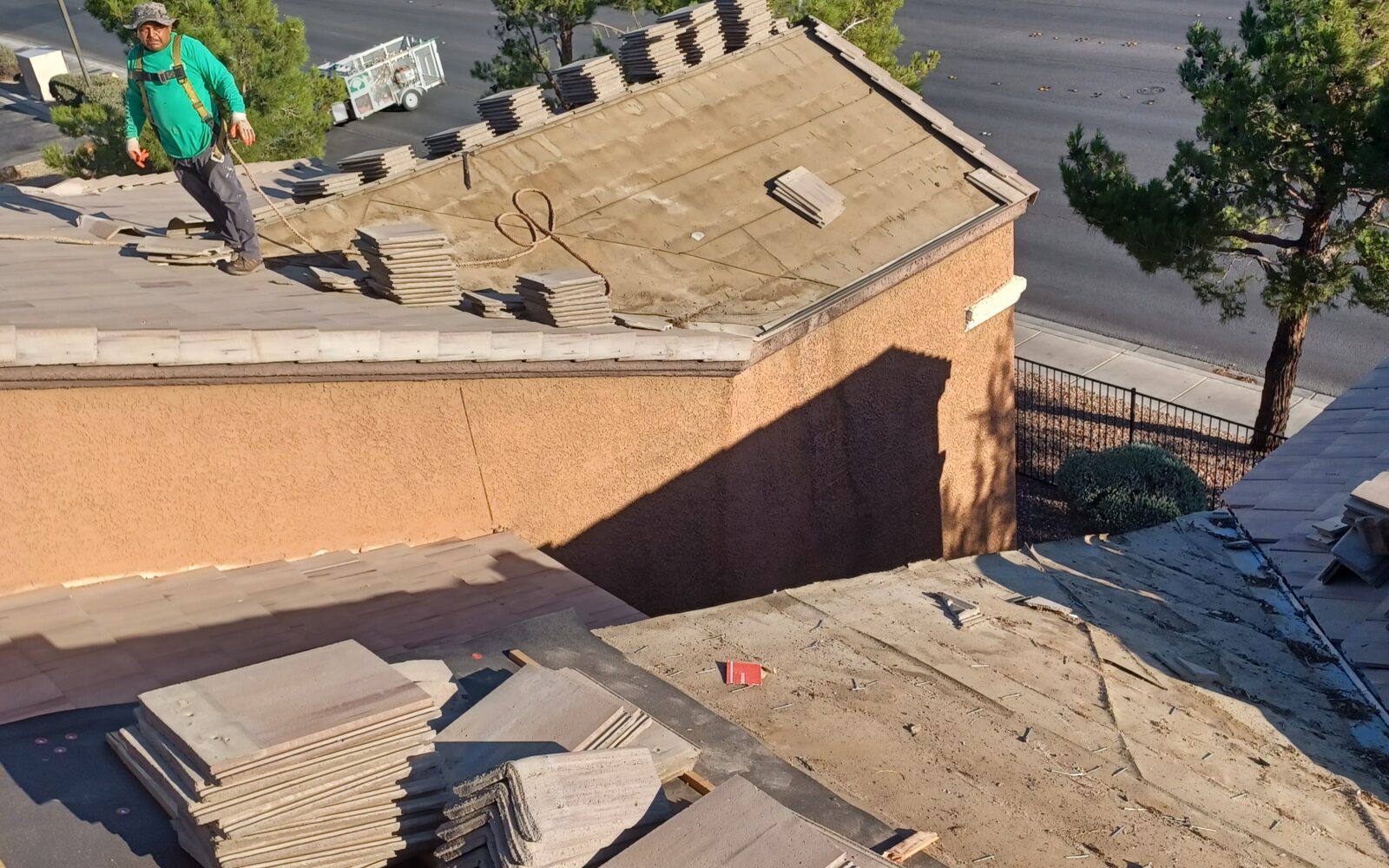
Insurance pays for a tile roof repair when a covered cause broke the tile, and the dispute is almost never about that. It is about scope: how far the repair has to reach, whether a matching tile can still be bought, and whether the felt or membrane under the tile has to be renewed to make the repair last.
That matters because a tile roof is two products doing two jobs. The tile takes the weather and the sunlight. The layer beneath it is what actually keeps water out of the building. A repair that replaces broken tile over a perished underlayment looks finished and is not, and a claim written that way pays for the visible half of the problem.
What a tile repair scope actually contains
| Item | Normally covered | Where it is argued |
|---|---|---|
| Replacing broken tile | Yes, where the cause is covered | Whether the count is complete |
| Lifting sound tile for access | Yes, where needed to reach the damage | How wide the access area has to be |
| Replacing underlayment | Only where the covered event damaged it | Age and wear against storm damage |
| Rebedding ridge and hip | Where the work disturbed it | Whether it was already failing |
| Breakage during the work | Contractor cost, in the price | Whether the allowance is reasonable |
| Disposal and access equipment | Yes, as part of the repair | Whether it appears in both estimates |
Six lines, and five of them can be missing from an estimate that still looks complete. Tile roof insurance claims covers how the damage itself is assessed. This page starts after that, with the work.
Cracked, chipped and weathered
A tile fails in three ways and only two of them are usually claimable. Impact fracture leaves a clean break, often with a bright edge where the body of the tile is exposed, and on concrete tile a bruise where the surface has been driven in. That is damage. Spalling, delamination and crazing across a whole slope are the tile reaching the end of its life, and no policy covers age.
The third is movement: a tile slipped or lifted because a fixing failed or the wind got under the course. Whether that is covered depends on the cause, which is why the inspection report should say what it found and what it thinks moved the tile, not just that the tile is out of place.
The distinction is worth understanding before anybody else draws it for you. An adjuster standing on a roof is deciding which of the three they are looking at, and the decision is made from the edges of the break, the pattern across the slope and the condition of the tile around it. An owner who has photographed the fresh breaks close up, with something in frame for scale, has already recorded the part of the evidence that weathers away fastest. Within a few months a bright fracture edge dulls, and a clean impact break starts to look like any other old damage on an old roof.
Matching, and when it decides the scope
Clay and concrete tiles are made in a profile and a colour, and both change over time. A roof laid twenty five years ago may have a profile that is no longer produced, or a colour that is no longer supplied. When neither can be bought, a repair cannot be completed to a uniform standard, and the question moves from repair to a wider scope.
Three practical steps settle it quickly:
- Identify the tile. Make, profile name and colour. The underside of a tile usually carries a maker’s mark.
- Ask a supplier in writing whether it is still produced, and keep the reply.
- Ask about salvage. A reclaimed match is sometimes available and sometimes a reason the carrier holds to repair.
An owner who can produce a supplier’s written confirmation that the tile is discontinued is in a different conversation from one who says the tiles do not match. What to expect from a roof insurance claim sets out where in the process that evidence lands.
The underlayment question
This is where tile claims turn difficult. In most assemblies the underlayment is the waterproofing, and it has a shorter life than the tile above it. On a roof where the tile is sound and the underlayment is finished, the right job is to lift the tile, renew the layer and relay. That is a maintenance project, and the fact that a storm broke a dozen tiles in the same week does not convert it into a covered one.
What is covered is the underlayment damage the event itself caused: a tear where a branch came through, the area opened up by wind, the section that has to be cut out to repair a penetration. Expect the carrier to draw that line tightly and expect to need photographs of the opened area to move it.
The practical answer is to have the scope written in two parts, so the covered repair and the recommended work are each priced on their own. Nothing is lost by asking, and a blended figure is the easiest thing in a claim for a carrier to reduce.
Breakage, access and who pays for it
Tile over about thirty years old breaks when it is walked, and the older the roof the higher the loss. That cost belongs to the contractor and should appear in the estimate as an allowance rather than as a surprise. Ask two questions before the work starts: how many spare tiles the price includes, and what happens if the allowance is used up.
Ask also to keep any sound tile that comes off the roof. Matching spares on site are worth more than their weight on a roof whose tile is no longer made, and they are the difference between a one day repair and a scope argument the next time something lands on the roof.
Why the two estimates disagree
A carrier’s estimate is produced from pricing software against the scope its adjuster recorded. A roofer’s estimate is produced from the scope the roofer intends to carry out. When the totals differ, the useful move is not to argue about the total but to lay the two scopes beside each other and find the lines that exist in one and not the other.
Access, breakage allowance, rebedding, disposal and the tile specification are where the differences usually sit. A supplement raised against a specific missing line, with the roofer’s written reason, is the ordinary mechanism and it is far more effective than a stronger opinion about price. The adjuster visit covers how to get the scope recorded properly in the first place, which saves most of this.
Where to go next
If the repair has been priced and the settlement does not reach it, how to get insurance to pay for a roof replacement covers the evidence that moves a scope. If the question is still whether the damage is claimable at all, go back to tile roof insurance claims.
This page explains how claims are generally handled. Your policy and your state decide what applies to yours, and nothing here is insurance or legal advice.
Common questions
How many broken tiles does it take before insurance pays for a repair?
There is no threshold. One tile broken by a covered cause is a covered loss, and the only practical limit is the deductible, which is usually far more than a handful of tiles costs to put right. The count matters for scope, not for coverage.
- Coverage turns on the cause, not on the quantity
- The deductible decides whether filing is worth it
- A low count often means paying for the repair directly
- Spread across slopes is what pushes toward a wider scope
- Damage that admits water is urgent at any count
Owners reasonably ask the question the other way round, which is how much damage it takes before the carrier stops talking about repair. That answer comes from the pattern rather than the total. Twenty broken tiles in one place after a branch fell is a repair. Twenty spread across four slopes after hail is evidence of an impact event the whole roof sat through, and the scope follows the evidence.
Will insurance pay to lift and relay a tile roof?
Only where the covered damage makes it necessary. Lifting and relaying sound tile to renew the layer beneath is maintenance when the underlayment has simply aged, and part of the repair when a covered event damaged the layer or the work cannot be done without lifting tile.
- Aged underlayment on its own is an excluded wear item
- Storm damage to the underlayment is a different question
- Access lifting needed to reach covered damage is claimable
- Expect the carrier to separate the two in the scope
- The roof's age shapes the valuation either way
This is the single largest figure in dispute on tile roofs, because a relay can cost several times what the broken tiles cost. The way to keep it straight is to ask the roofer to write the scope in two parts: work required to repair the covered damage, and work they recommend while the tile is off. Both are reasonable requests. Only one of them is the insurer's.
Does an insurer pay for a tile repair that only reaches part of the slope?
Usually yes, because a tile roof is repairable unit by unit in a way a sealed membrane is not. A partial repair is the carrier's default position, and it holds unless matching fails or reaching the damage would disturb sound tile across a wider area.
- Tile is laid in courses, so local repair is normally practical
- Interlocking profiles still need neighbouring tiles lifted
- Mortar bedded ridges and hips are harder to repair locally
- Colour difference on a weathered roof is expected, not a defect
- Some states require a reasonably uniform appearance
The argument people expect to win on appearance is usually lost, because a repair is held to restoring function rather than matching a sun faded finish. The arguments that succeed are about feasibility: the profile is no longer produced, or the hip line has to be taken off and bedded again to reach the damage. State those in the scope and the partial repair position tends to move.
Who is liable if more tiles break during the repair?
The contractor doing the work, not the insurer. Breakage caused by access is a cost of the job and belongs in the roofer's price. A good estimate allows for it openly, which is why a line for replacement tile beyond the damaged count is normal rather than suspicious.
- Access breakage is a contractor cost, not a new loss
- Brittle older tile breaks more readily, and roofers know it
- Ask how the allowance is priced before work starts
- Walking boards and crawl boards reduce the count
- Keep any salvaged sound tile on site as spares
Two things are worth agreeing in writing before anyone goes up. First, what happens if the breakage allowance runs out, since on a roof over thirty years old it often does. Second, who keeps the usable tile that comes off. A stock of matching spares in the garage is the cheapest insurance a tile roof has, and it disappears into a skip if nobody asks for it.
Why is the tile repair estimate higher than the insurer's figure?
Nearly always because the two documents describe different work. The carrier's figure is built from its own pricing software against the scope its adjuster recorded, and the roofer's is built from the scope the roofer intends to carry out. Compare the scopes before comparing the totals.
- Check whether both include access, breakage and disposal
- Check whether ridge and hip rebedding appears on both
- Check the tile described, since profiles vary in price
- Check whether one assumes a relay and the other does not
- Ask for the carrier's estimate as a line by line document
Once the scopes are set side by side, most of the gap resolves into two or three identifiable items rather than a general disagreement about price. That matters, because a carrier will revisit a missing line far more readily than a total it considers reasonable. A supplement raised against a named omission, with the roofer's reason attached, is the normal route and it works more often than argument does.